
The 12-Hour vs 24-Hour RAP — Why Reserve Rules Shape Your Entire Life
Ask a flight attendant what matters most about reserve and you’ll get a list. Pay. Base. Seniority. How often you actually get called.
But there’s one thing that shapes daily life more than any of those — and most people outside the industry have never heard of it.
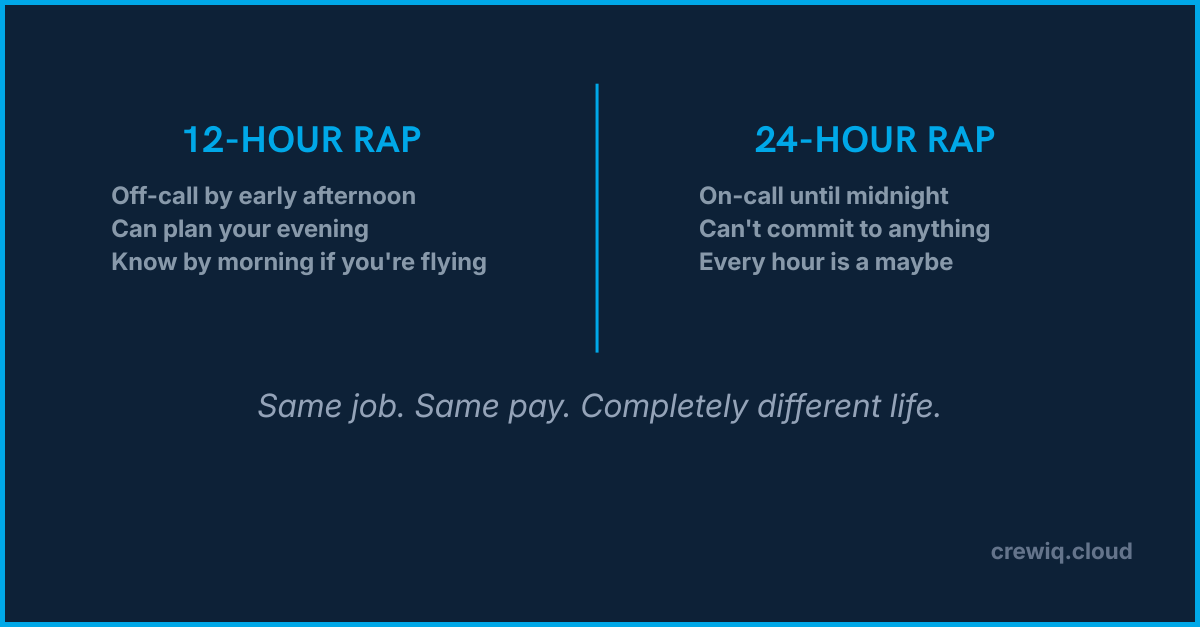
It’s called the Reserve Availability Period. RAP for short. And the difference between a 12-hour RAP and a 24-hour RAP is the difference between having half a day to yourself and having none.
What RAP actually means
When you’re on reserve, the airline doesn’t necessarily need you to fly. But they need you to be available in case they do. Your Reserve Availability Period is the window during which the airline can call you in.
At American Airlines, that window is roughly 12 hours. You know when it starts and when it ends. If your RAP runs from 5am to 5pm, then at 5:01pm you’re off. Free. Done. You can make dinner plans. You can go out. You can stop checking your phone.
At United Airlines, the RAP is 24 hours.
That means from midnight to midnight — or whatever your reserve day covers — the airline can call you at any point. Morning. Afternoon. Evening. Middle of the night. There’s no window where you’re definitively clear.
Twelve hours of uncertainty is stressful. Twenty-four hours of it is a lifestyle.
The Reddit post that made this click for me
I was reading through r/flightattendants and someone had just received conditional job offers from both United and American. Living in California, so SFO and LAX were easy UA bases. The pay comparison, the training differences, the base options — all that was in the post.
But the line that jumped out was this: “the 24-hour reserve feels intimidating as a new hire.”
Not the pay. Not the base locations. The 24-hour reserve.
This person hadn’t even started training yet, and the thing keeping them up at night wasn’t money — it was the thought of an entire day, every reserve day, where they couldn’t commit to a single thing.
The responses from experienced crew confirmed it. One said the unpredictability at UA is harder than the actual flying. Another pointed out that with a 24-hour RAP, picking up a side job is nearly impossible. You can’t commit to a shift somewhere else if you might get called at 3pm. Or 9pm. Or 2am.
Why this matters more than pay
I know that’s a bold claim. But hear me out.
A pay difference of a few dollars per flight hour is real. It adds up over a month. But you can budget around a known income, even a low one. You adjust your spending. You find a cheaper crashpad. You pick up trips when you can.
What you can’t budget around is not knowing when you’re working.
With a 12-hour RAP, you get half the day guaranteed. You can schedule a gym class. Take your kid to school. Meet a friend for lunch — or dinner, depending on your window. You have a rhythm. It’s not a great rhythm, but it’s something.
With a 24-hour RAP, there is no rhythm. Every plan is tentative. Every commitment comes with “unless I get called.” You stop making plans because the cost of cancelling — emotionally, socially — is worse than just staying home.
A former flight attendant posted on Reddit that reserve life would be “impossible with a child.” She wasn’t at a 12-hour RAP airline. She was talking about 24-hour availability — the kind where you genuinely cannot arrange reliable childcare because you don’t know if you’ll need it at 6am or 6pm or not at all.
Short-call vs long-call makes it worse
Within any RAP, there are usually two types of reserve: short-call and long-call.
Short-call typically means you need to be at the airport within 2-3 hours of being contacted. You’re essentially on standby at home, bag packed, ready to go. Some airlines require you to be within a certain distance of the airport.
Long-call gives you more notice — often 12+ hours before you need to report. You know the night before that you’re flying tomorrow. It’s still unpredictable, but at least you can sleep without one eye on your phone.
The problem is that at a 24-hour RAP airline, even long-call doesn’t help as much as you’d think. You might know you’re flying tomorrow, but today — your “day off” from flying — you’re still technically available. Still unable to fully commit to anything. The mental load doesn’t switch off just because the phone hasn’t rung yet.
How PBS fits into this
If you’ve been following the United contract negotiations, you’ll know there’s a big debate about PBS — Preferential Bidding System. American already has it. Delta has it. United is being pushed toward it.
PBS changes how schedules are built. Instead of the airline publishing set lines and crew bidding on them, crew submit preferences and an algorithm builds the schedule around those preferences (weighted by seniority, naturally).
Some crew think PBS is better for reserve. Others think it’s worse. The truth is probably that it depends on the implementation.
But here’s what PBS doesn’t change: if your RAP is 24 hours, PBS won’t shorten it. The algorithm decides what trips you fly and when — but the window during which you’re available to be called stays the same. PBS is about schedule assignment. RAP is about daily availability. They’re different systems solving different problems.
I’ve seen crew from American say they actually prefer PBS because it gives them more control over their overall monthly pattern. But they still deal with the RAP when they’re on reserve days. The bidding system doesn’t override the contractual availability window.
The comparison nobody makes
When new hires are choosing between airlines — and I’ve seen dozens of these posts on Reddit — the conversation almost always centres on pay rates, training length, base locations, and company culture.
Almost nobody talks about RAP.
I think that’s because it’s one of those things you don’t understand until you’re living it. The words “12-hour reserve availability period” mean nothing to someone who hasn’t experienced the relief of their RAP ending at 5pm. And “24-hour reserve” sounds fine on paper until you’re six months in and you haven’t made a plan with confidence in weeks.
If I were advising someone choosing between two airlines today, I’d tell them to look at the RAP before the pay table. You can earn more money later. You can upgrade bases. You can gain seniority.
But you can’t get back the months you spent sitting at home, not because you were flying, but because you might have been.
What this means for CrewIQ
This is one of the reasons I’m building CrewIQ the way I am. The reserve predictor doesn’t just show your probability of being called — it accounts for your specific airline’s RAP structure, the time of day, and the patterns at your base.
Because “you’re number 6 in the queue” means something completely different at a 12-hour RAP airline versus a 24-hour one. Position 6 with a RAP ending in two hours is a very different situation from position 6 with sixteen hours of availability remaining.
The goal isn’t to change the rules. It’s to give crew members enough information to work within them — and to stop losing their lives to uncertainty that’s actually more predictable than it feels.
If you’re on reserve and the RAP is the thing that gets you — I’d like to hear how you manage it. Genuinely. Every conversation I have makes CrewIQ better at understanding what crew actually need.