What Airlines Know About Your Sick Leave That You Don’t
Sick leave abuse has overtaken inappropriate social media posts as the number one reason flight attendants are being terminated at United Airlines. Not safety violations. Not customer complaints. Sick leave patterns — identified by technology that most crew members don’t even know exists.
That’s according to a report this week from Paddle Your Own Kanoo, one of the most widely read aviation crew publications online, and it paints a picture that every reserve flight attendant should be paying attention to.
The dots are being connected
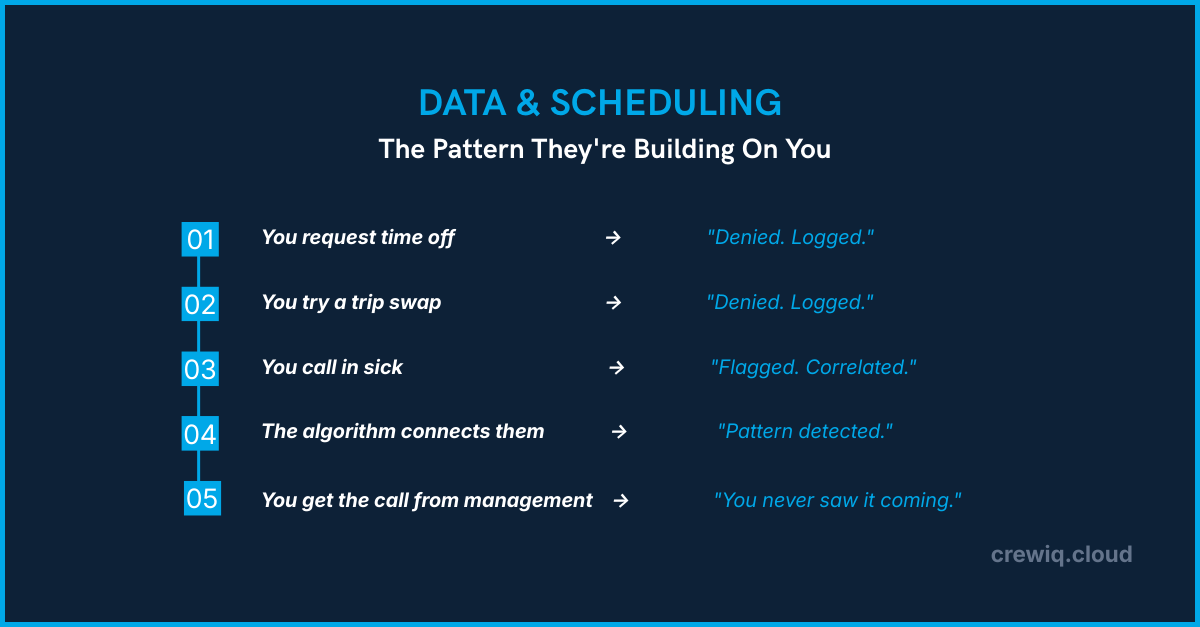
Here’s what’s changed. United isn’t just counting sick days anymore. They’re using technology to look across systems — trip swap requests, time-off denials, scheduling disputes, sick call timing — and connecting them together to build a case.
So if you tried to swap a trip and couldn’t, then called in sick the same day, that’s a dot. If you had a time-off request denied and then went sick on that date, that’s another dot. If you had a disagreement with crew scheduling and then reported an injury a few hours later, that’s a third.
Individually, each of those could be completely legitimate. A lot of them probably are. But the airline’s system doesn’t see context. It sees correlation. And right now, correlation is apparently enough to end your career.
The problem with pattern-matching people
The Association of Flight Attendants has been vocal about where this breaks down, and their examples are worth reading carefully.
Think about a crew member who’s on a genuine vacation but catches a stomach bug and can’t fly home for their next trip. To the system, that looks like someone extending their holiday with a fake sick call. Or consider a flight attendant who challenges scheduling about a callout — a completely normal thing to do — and then cuts herself later that same day and genuinely can’t work. The system sees the scheduling dispute followed by a sick call and flags it as suspicious.
These aren’t hypothetical edge cases. These are the kinds of situations the union says are actually resulting in terminations.
This didn’t happen overnight
What makes this story particularly worth understanding is that it’s not a sudden policy change. It’s the latest step in a pattern that’s been escalating for almost two years.
In July 2024, United introduced a policy requiring flight attendants to provide a doctor’s note if they called in sick on a weekend, after the airline said weekend sick call rates had surged. The union called it reprehensible and challenged it legally. But when it reached an independent arbitrator in mid-2025, the ruling went United’s way — the arbitrator said the flight attendant contract gave United the power to demand medical certification when there was evidence of sick leave misuse.
Around the same time, United started requiring crew to give at least eight hours’ advance notice that they were going to be sick — or face a performance warning that could lead to termination. Think about that for a second. Eight hours’ notice. For being sick. The union challenged that too, and lost again.
Then in mid-2025, a leaked internal email showed United was demanding what they called “substantial medical facts” from crew members requesting FMLA leave, and warning that the information would be used not just to assess the leave request, but to determine whether the flight attendant was fit to keep working at all. Reports also surfaced that the airline had hired private investigators to follow crew members who were on approved sick leave.
And it’s not just United. At the end of 2025, Frontier sent an unusually blunt email to its own flight attendants, saying the frequency and timing of sick calls had become “unacceptable and unsustainable” and that “drastic action” was now necessary.
The bit nobody talks about
I want to be clear about something. I’m not cabin crew. I’m a founder building tools for crew, and I come at this from the information design side, not the union politics side. I’m not here to argue whether airlines have a right to manage attendance — they obviously do. Every operation depends on reliability, and sick leave abuse is a real thing that affects other crew members, not just the airline.
But here’s what strikes me about this whole story, and it’s the same thing I keep running into when I talk to reserve crew about their daily reality.
The airline has a system. That system is watching, correlating, and making judgments. And the crew member on the other side of it has almost no visibility into what data trail they’re leaving or how it’s being interpreted.
Every time you interact with scheduling — every swap attempt, every time-off request, every bid preference, every sick call — you’re creating data points. And those data points are now being read together, as a pattern, by technology that’s specifically designed to find suspicious correlations.
You might know you were genuinely sick. But do you know what the system saw?
What this actually means for reserve crew
If you’re on reserve, this hits differently. Your relationship with scheduling is already more intense than a lineholder’s. You’re interacting with the system constantly — checking your availability period, hoping for or dreading a callout, trying to swap assignments, requesting time off around the edges of your window.
Every one of those interactions is, apparently, a data point now. And the gap between what you know about your own situation and what the airline’s technology infers from your behaviour is getting wider, not narrower.
That gap — between what the airline sees and what the crew member knows — is the thing I keep coming back to. It’s the same gap that makes reserve scheduling feel so opaque in the first place. Airlines have always held more information than crew. What’s different now is that they’re actively using it to build termination cases, and crew still have no equivalent visibility into their own patterns.
I don’t think the answer is to stop using sick leave when you’re genuinely sick. And I don’t think the answer is to avoid interacting with scheduling. But I do think every flight attendant should understand that those interactions are being watched, correlated, and scored — and plan accordingly.
The information asymmetry in aviation isn’t just about when you’re going to fly. It’s about what the airline sees when you don’t.