Your Airline Is Watching Your Schedule. Nobody’s Watching Back for You.
United Airlines just made something official that most flight attendants already suspected.
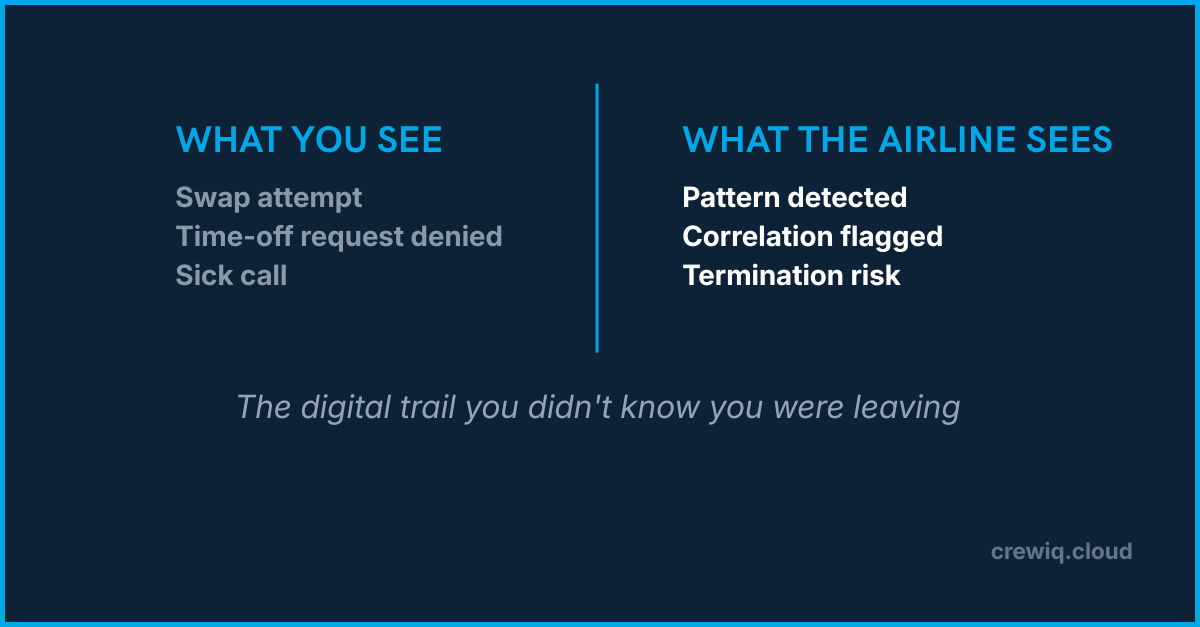
The airline is using data analytics to monitor crew scheduling patterns — tracking swap attempts, time-off requests, and sick calls — and connecting the dots between them. If you try to swap a trip, get denied a day off, and then call in sick for the same period, the system flags it. Automatically.
Sick leave pattern-matching is now the number one reason flight attendants are being terminated at United.
Let that sit for a second.
The digital trail you didn’t know you were leaving
Here’s what most crew don’t realise: every action you take inside your airline’s scheduling system creates a data point. Swap requests. Trip drops. Open time pickups. Sick calls. They’re all logged, timestamped, and — at United — now being analysed for patterns that “suggest misuse.”
The airline doesn’t need to spy on you. They don’t need a private investigator following you around (although that’s happened too). They just need the scheduling system you already use every day.
You’re generating the evidence. They’re building the case.
The AFA-CWA — the union representing United’s cabin crew — has pushed back hard on this. Their argument is straightforward: digital footprints don’t always reflect intent. A crew member who takes a legitimate holiday, catches a stomach bug, and can’t fly home in time for their next assignment will look exactly the same in the data as someone gaming the system.
But here’s the thing. The airline doesn’t have to prove you gamed it. They just have to show the pattern exists. An independent arbitrator already ruled in United’s favour on this — the airline has the contractual authority to require medical documentation when circumstances suggest misuse.
This isn’t just United
Emirates requires flight attendants who call in sick to physically present themselves at the airline’s own medical centre for verification. If you’re unwell at 2am after a long-haul rotation, you still have to get yourself to the clinic. That’s the system.
And it’s not just legacy carriers with deep pockets for analytics. In February 2026, the AFA chapter for Endeavor Air — a Delta Connection regional — warned members about a “significant increase in investigatory meetings related to pass travel violations.” Flight attendants had been using their free standby travel benefits while on sick leave or FMLA. The airline didn’t need a pattern engine for this one. When you call out sick and your employee ID shows up on a standby list the same day, the system flags itself. Violations resulted in written warnings and suspended travel privileges. The union reminded crew that the only exception under the CBA is flying home after calling in sick — and even that requires written manager approval first.
Other carriers have their own versions. Some are more transparent about it than others. But the direction of travel is clear across the industry: airlines are investing in data infrastructure to monitor crew behaviour, and they’re getting more sophisticated at it every year.
The crew scheduling systems that run your daily life aren’t just operational tools. They’re surveillance tools. And they’ve been quietly collecting data on your patterns for longer than most people realise.
The asymmetry that nobody talks about
I wrote about this in an earlier post — What Airlines Know About Your Sick Leave That You Don’t. The core problem hasn’t changed. If anything, United’s announcement makes it worse.
Airlines have predictive analytics watching your patterns. Crew have nothing watching back for them.
Think about what United has built. They’ve got a system that correlates scheduling activity with sick calls across their entire O’Hare operation. It flags sequences automatically. It generates investigation triggers without a human needing to manually review every case.
That’s data science applied to workforce management. And it’s entirely one-directional.
Crew don’t have anything comparable working in their favour. No system that tracks base-level staffing trends. No tool that shows historical callout probability by day of week. No way to see whether their queue position means they’re likely to fly tomorrow or not. The airline has a pattern engine. Crew have a phone that might ring.
The contract negotiations make this worse
United’s flight attendants are still working under a contract that became amendable in 2021. They rejected a tentative agreement in 2025 that offered pay rises but failed to address quality-of-life issues — scheduling, rest protections, and yes, sick leave policies.
The union’s position is that the aggressive attendance monitoring is part of a broader strategy to keep labour costs in check while delaying a better contract. Whether you agree with that framing or not, the practical effect is the same: crew are operating under tighter surveillance with fewer protections than they’ve been asking for.
And in that environment, the information gap becomes even more dangerous. If your airline is using data to build a case against you, and you don’t have data to understand your own patterns, you’re playing a game where only one side can see the board.
What this actually means for reserve crew
If you’re on reserve, this hits differently.
Reserve crew already live with the most unpredictable schedules in the industry. You don’t choose when you fly. You don’t always know when you’ll be called. Your entire day — your entire week — revolves around a phone that might ring at any moment during your Reserve Availability Period.
Now layer this on top: every time you request a swap, every time you pick up open time, every time you call in sick, the system is watching. Not a person. A pattern engine. And it doesn’t know why you called in. It doesn’t know your spouse was in hospital. It doesn’t know your kid had a fever. It just sees the sequence.
Swap denied. Sick call filed. Pattern flagged.
I’ve spoken to crew who say the anxiety isn’t about getting called in anymore. It’s about the metadata they’re generating just by existing in the system. They’re second-guessing whether requesting a swap will look bad if they later need to call in sick — even for a completely legitimate reason.
That’s not crew gaming the system. That’s crew being afraid of the system.
The question nobody’s asking
Whenever this topic comes up — and it comes up a lot on crew forums — the conversation splits into two camps. One side says airlines need to crack down on abuse. The other says the monitoring has gone too far.
Both sides are missing the point.
The real question isn’t whether airlines should use data to manage their workforce. Of course they should. Scheduling 25,000+ flight attendants across a global operation requires sophisticated systems.
The real question is: why does only one side have the data?
Airlines have pattern engines, correlation tools, and automated flagging systems. Crew have a PDF roster and a group chat. The information asymmetry isn’t a bug in the system. But it is fixable.
If airlines can use historical data to predict which crew behaviours look suspicious, then crew should be able to use historical data to predict when they’re likely to fly, plan their lives, and make informed decisions about their schedules.
That’s not a radical idea. That’s just symmetry.
What comes next
The United story will generate a lot of noise. Union statements. Industry commentary. Reddit threads. But the underlying trend won’t reverse. Airlines will continue investing in data-driven workforce management because it works. The technology will get more sophisticated, not less.
The question for crew is whether they’ll have any equivalent. Whether the same data that airlines use to monitor them can be turned around to actually help them — to predict their schedules, reduce their uncertainty, and give them something better than “it depends” when they’re trying to plan their lives.
That’s what I’m building. That’s what this whole project is about. Not because I think airlines are wrong to use data. But because I think crew deserve to have some too.